You finished your degree. You built your life here. You were ready to apply for your 485 visa and keep building your future in Australia — and then, overnight, the price tag doubled.
On 1 March 2026, the Australian Government doubled the application fee for the Temporary Graduate visa (Subclass 485) from $2,300 to $4,600 for the primary applicant — the largest single-day fee increase in the program's history. No advance warning was given to students, migration agents, or universities. For thousands of graduates who had been planning and saving based on the old price, it was a shock.
If you're an international graduate in Australia right now — whether you're about to apply, mid-planning, or just trying to understand what changed — this article has everything you need. We'll break down the new fees, who is exempt, what the 485 still gives you, the other recent rule changes you need to know about, and what to do next.
As of April 2026, this article reflects the most current information available. Always verify fees and eligibility at immi.homeaffairs.gov.au before lodging your application.

What Is the 485 Visa and Why Does It Matter?
The Temporary Graduate visa (Subclass 485) is one of the most important visas in Australia for international students. It is the main post-study work pathway — allowing you to live, work, and study in Australia after completing a CRICOS-registered qualification. Crucially, it gives you full and unrestricted work rights, meaning you can work for any employer in any industry, full-time, without needing a job offer to apply.
For most international graduates, the 485 is not just a temporary visa — it is the first real step toward building the Australian work experience and points needed for permanent residency through the skilled migration system. Without it, the path to PR becomes significantly harder.
Here is what the 485 still offers despite the fee increase:
- Full, unrestricted Australian work rights (any employer, any field)
- The ability to include your partner and dependent children in your application
- Freedom to travel in and out of Australia while the visa is valid
- Time to accumulate skilled work experience and English points for PR applications
- Access to pathways including the 189, 190, 491, and employer-sponsored 482 visas
It remains one of the most valuable post-study work visas in the world — even at the new price.
SettleMate's Tip: SettleMate recommends that international graduates treat the 485 visa as a strategic investment, not just an administrative step. The Australian work experience you build during this visa period is directly points-tested in the skilled migration system — and those points can be the difference between receiving an invitation to apply for PR or waiting years for one. Plan the visa and plan what you do during it at the same time.
The New 485 Visa Fees: What You Will Pay From 1 March 2026
The fee change was introduced under the Migration Amendment (Temporary Graduate Visa Application Charge) Regulations 2026 and applies to all applications lodged on or after 1 March 2026. Applications lodged before that date are not affected.
Standard fees — most international graduates:
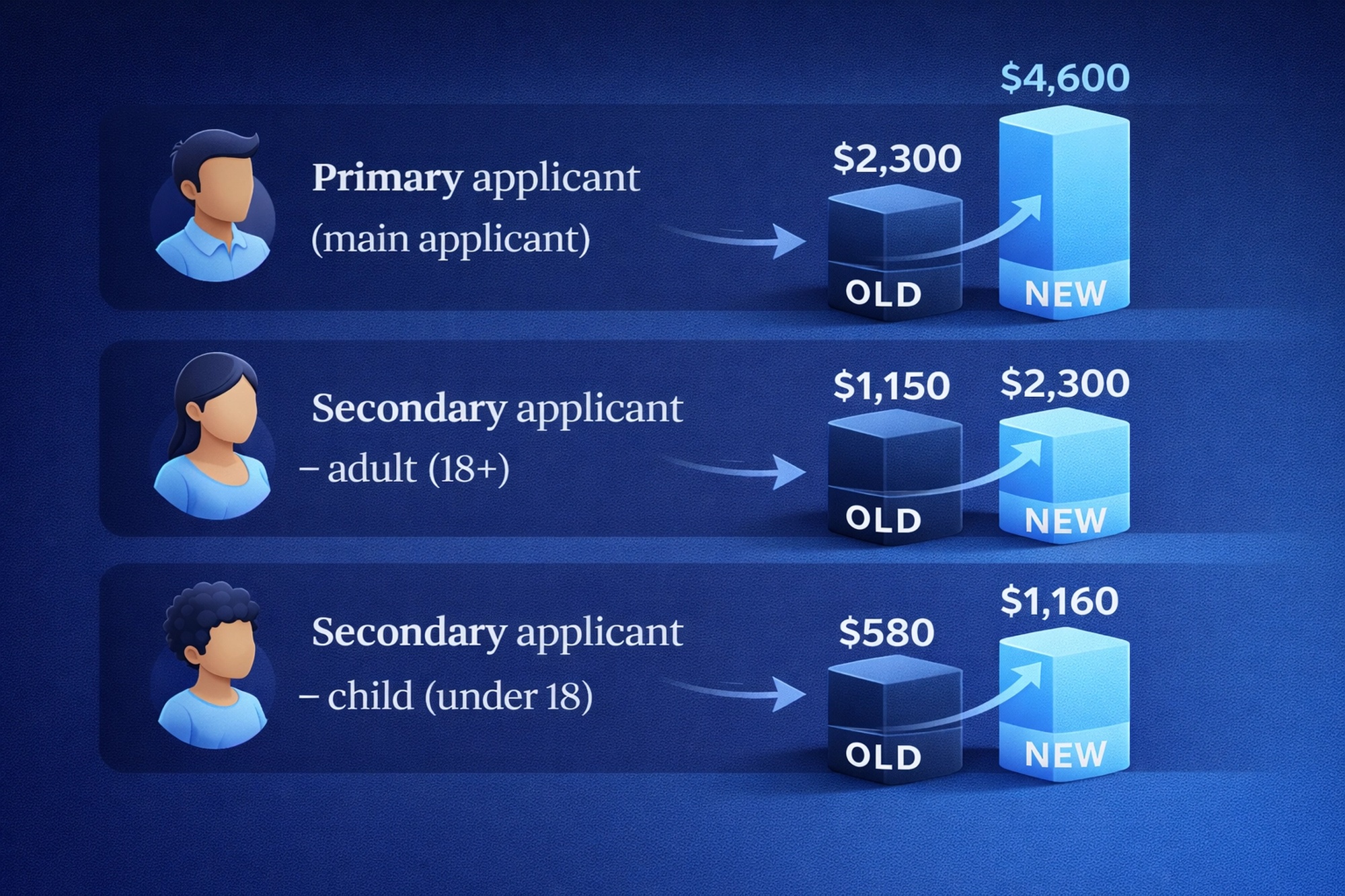
For a single applicant, the upfront government charge is now $4,600. For a couple applying together, that is $6,900. Add one child and you are looking at $8,060 — before health insurance, police checks, medical examinations, or any migration agent fees.
Reduced fees — Pacific Island and Timor-Leste passport holders:
If you hold a passport from an eligible Pacific Island country or Timor-Leste, you continue to pay the pre-existing fee of $2,300 for the primary applicant. This concession was maintained to reflect Australia's regional ties with Pacific nations.
Second Post-Higher Education Work stream (regional extension):
If you are applying for the Second Post-Higher Education Work stream — the additional 1 to 2 year extension available to graduates who studied and lived in a designated regional area — the fee for this stream is lower. The current charge is from $1,810 (increased from $905). Check the Department of Home Affairs visa pricing estimator for the exact figure at time of lodgement.
SettleMate's Tip: SettleMate wants to be clear on one important point: the government visa application charge (VAC) is non-refundable if your visa is refused. At $4,600, the financial cost of a refused application is now very significant. This makes correct stream selection, valid English test results, and complete documentation more critical than ever. If you are unsure about any part of your application, speak to a MARA-registered migration agent before you lodge.
Get personalised help →
Everything Else That Changed: The Full 2026 Picture
The fee increase is the biggest headline, but it did not arrive alone. The 485 program has undergone significant changes since 2024, and if you are reading older information, some of it will no longer apply. Here is the current state of the key rules:
🎂 Age limit: Under 35 for most applicants
The age limit for the 485 visa was reduced from under 50 to under 35 for most applicants. You must be under 35 at the time the Department of Home Affairs receives your application.
Exceptions:
- Graduates of a Master's by Research or PhD degree: age limit remains under 50
- Hong Kong SAR or British National (Overseas) passport holders: age limit remains under 50, and visa duration can extend to up to 5 years
📝 English language: IELTS 6.5 overall, valid for 12 months only
The minimum English requirement for the 485 visa is now an overall IELTS score of 6.5, with no individual band (listening, reading, writing, speaking) below 5.5. Equivalent scores in PTE Academic, TOEFL iBT, CELPIP, and other approved tests are accepted.
Critically, your English test result must have been taken within 12 months of your application date. The previous 3-year validity window is gone. If your existing test result is older than 12 months, you will need to resit before lodging.
Some nationalities may be exempt from providing an English test — check the Department of Home Affairs website for the current exemption list.
⏱️ Apply within 6 months of course completion — no exceptions
You must lodge your 485 application within 6 months of completing your eligible qualification. This is calculated from the date on your official completion letter from your education provider — not your graduation ceremony, not your final marks release. If you miss this window, you become ineligible. There are no extensions.
📋 The main visa streams and how long each lasts
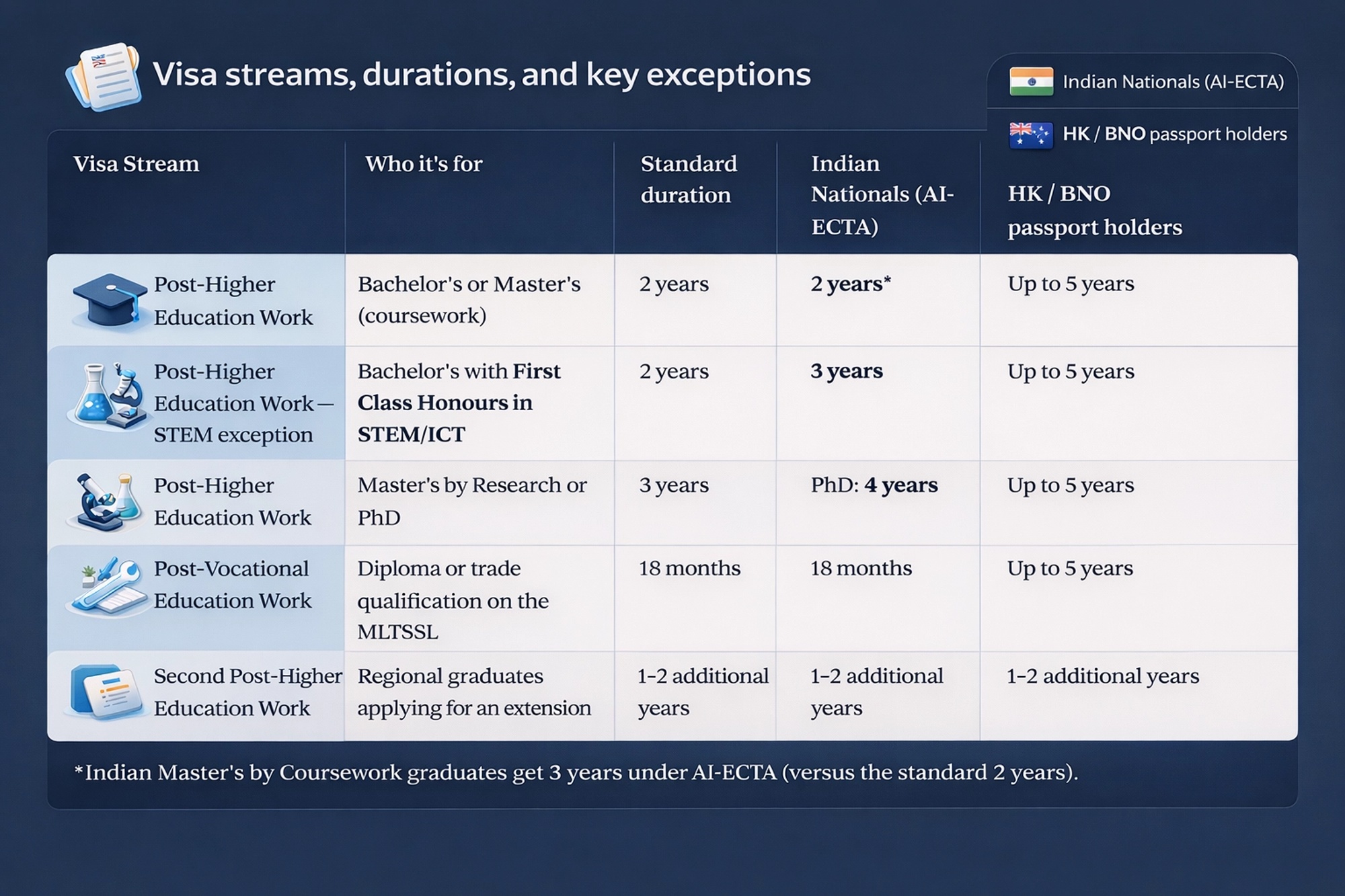
The Second Post-Higher Education Work stream is only available to graduates who studied and lived in a designated regional area during their original 485 visa. The additional duration depends on whether your institution was in a Category 2 (Regional Centre — e.g., Perth, Adelaide, Gold Coast) or Category 3 (Other Regional Areas) location.
A note for Indian graduates: Under the Australia-India Economic Cooperation and Trade Agreement (AI-ECTA), Indian passport holders are entitled to extended stay periods for certain qualifications. The most notable benefit is for graduates with a Bachelor's degree with First Class Honours in a STEM or ICT field (3 years instead of 2), Master's by Coursework graduates (3 years instead of 2), and PhD graduates (4 years instead of 3). These extended durations are applied at the time of visa grant based on your passport and qualification — you don't need to do anything special to claim them. Always confirm the applicable duration with a MARA-registered migration agent for your specific qualification and circumstances.
SettleMate's Tip: SettleMate recommends that Indian graduates — particularly those completing STEM degrees or postgraduate coursework — check whether their AI-ECTA entitlements apply before lodging their 485 application. The difference between a standard 2-year grant and a 3-year grant under AI-ECTA can significantly affect your PR pathway timeline and the number of skilled work experience points you accumulate. This is one of the most underutilised advantages available to Indian graduates in Australia.
🚫 You can no longer switch onshore from a visitor or 485 visa to a student visa
From 2 February 2026, the government's "no visa hopping" reforms blocked onshore switching from visitor visas and 485 graduate visas to student visas. If you are on a 485 and thinking about returning to study onshore as a way to extend your stay, that path has been closed.
SettleMate's Tip: SettleMate recommends that graduates who are considering further study as a pathway to PR plan their next move carefully under the new rules. Returning to study is still possible — but it needs to be planned properly with the right visa pathway, not as an onshore switch. A MARA-registered migration agent can map out the correct approach for your specific situation.
What This Means for You Right Now
Whether you are about to apply, still studying, or trying to figure out your next move, here is the practical action list:
If you haven't lodged your 485 yet:
- Budget for $4,600 as the minimum government charge — plus roughly $1,500–$3,000 in additional costs (Overseas Visitor Health Cover, police checks, medicals, English test if needed)
- Confirm your stream — Post-Higher Education Work or Post-Vocational Education Work
- Check your age — you must be under 35 at the time of lodgement (unless exempt)
- Check your English test date — it must be from within the last 12 months
- Count 6 months from your official completion letter date — that is your hard deadline
- Apply via ImmiAccount at online.immi.gov.au
If you are currently on a 485 visa:
- Explore the Second Post-Higher Education Work stream if you studied in a regional area
- Use this time strategically — build skilled work experience for PR points
- Research your PR pathways now: 189 Skilled Independent, 190 State Nominated, 491 Regional, or Skills in Demand (482 / 186 employer-sponsored)
If you are still studying:
- Factor the new $4,600 fee into your financial planning before you finish your degree
- Get your English test done before your course ends — you want a valid result ready
- Start your Australian Federal Police check application early — it can take time
SettleMate's Take
SettleMate understands this fee increase has been genuinely difficult for many graduates — especially those who had been budgeting and planning for months only to find the price double overnight. That frustration is completely valid. At the same time, the 485 visa continues to be one of the most powerful tools available to international graduates in Australia. The two to three years of unrestricted work rights it provides — and the skilled experience those years produce — can still build a clear path to permanent residency. The cost is higher, but the value of what it unlocks has not changed. Plan carefully, get the details right on your first attempt, and use every month of that visa with your PR goals in mind.
Frequently Asked Questions
Q: What is the new 485 visa fee in 2026? From 1 March 2026, the government application charge for most primary applicants is $4,600. Secondary applicants aged 18 and over pay $2,300, and those under 18 pay $1,160. Eligible Pacific Island and Timor-Leste passport holders continue to pay the previous rate of $2,300.
Q: Why did the Australian Government double the 485 visa fee? The Department of Home Affairs stated the increase is part of broader efforts to "restore integrity" to the post-study work pathway, which the government believes has been used as a default extension mechanism by some graduates without clear long-term plans. Revenue from the increased fees will fund tougher Genuine Student assessments and expanded compliance activity.
Q: I already started preparing my documents before 1 March — do I still pay the new fee? Yes. The new fee applies based on the date your application is lodged, not when you started preparing or when you became eligible. Any application lodged on or after 1 March 2026 is subject to the $4,600 charge, regardless of when documents were gathered.
Q: Is the 485 visa fee refundable if my application is refused? No. The government visa application charge is non-refundable if your visa is refused. This makes it critically important to ensure your application is complete, in the correct stream, and meets all requirements before lodging.
Q: I am 36 years old — can I still apply for a 485 visa? For most applicants, the age limit is under 35 at the time of lodgement. However, if you are a graduate of a Master's by Research or PhD degree, or if you hold a Hong Kong SAR or British National (Overseas) passport, the age limit is under 50. Check your specific circumstances carefully.
Q: My IELTS result is from 18 months ago — can I use it for my 485 application? No. English test results must be from within 12 months of your application date. A result older than 12 months will not be accepted and your application may be refused. Book a new test as early as possible.
Q: I am an international student currently on a student visa — do I need to worry about the fee increase? If you are still studying and have not yet graduated, the fee increase is something to factor into your financial planning for after you finish. You will pay the new $4,600 fee when you eventually lodge your 485 application, so factor this into your savings plan now.
Q: Can I extend my 485 visa or apply for a second one? In most cases, no — the 485 visa is a one-time grant. However, graduates who studied and lived in a designated regional area may be eligible for the Second Post-Higher Education Work stream, which provides an additional 1 to 2 years. This has its own application charge (from $1,810) and its own eligibility criteria.
Q: Where can I find the official fee information and apply? The Department of Home Affairs maintains the official visa listing and fee schedule at immi.homeaffairs.gov.au/visas/getting-a-visa/visa-listing/temporary-graduate-485. Always verify fees using the Department's visa pricing estimator before lodging, as charges can change.
📌 Official & Trusted Resources
This article is informed by:
- Department of Home Affairs — Temporary Graduate visa (Subclass 485): immi.homeaffairs.gov.au
- Migration Amendment (Temporary Graduate Visa Application Charge) Regulations 2026 — Federal Register of Legislation: legislation.gov.au
- Fair Work Ombudsman — Work rights for visa holders: fairwork.gov.au
Disclaimer
This article is for general informational purposes only and does not constitute legal, migration, tax, or financial advice. SettleMate is not a registered migration agent. Always verify information through official Australian government sources. For visa and migration matters, consult a registered migration agent (MARA agent) for personalised advice.