Apply for the 485 Graduate Visa in Australia Without a Consultant: A DIY Guide for 2026
As of May 2026
You've done the hard part. Years of study, assignments, exams, and navigating a new country — and now you've got your degree. The next question most international graduates face immediately after finishing is: what now?
For most, the answer is the Temporary Graduate Visa (Subclass 485). It is the main legal pathway to stay in Australia after graduation, work full-time without restrictions, and start building toward permanent residency. And the good news is that for the majority of graduates with a straightforward study history, you can apply for it yourself — without paying thousands to a migration agent.
But here is the honest truth: the 2026 rules are more specific and more unforgiving than they were two years ago. The fee doubled on 1 March 2026 to $4,600 — and it is non-refundable on refusal. The health insurance requirement trips up thousands of applicants who assume their student cover still qualifies (it does not). And a simple timing error on your six-month lodgement window can make you ineligible entirely.
This guide exists so none of that happens to you. SettleMate will walk you through everything — eligibility, streams, documents, the correct health insurance, step-by-step lodgement through ImmiAccount, and the six mistakes most likely to get your application refused.
Let's make this straightforward.
What Is the 485 Visa and What Does It Give You?
The Temporary Graduate Visa (Subclass 485) is a post-study work visa issued by the Australian Department of Home Affairs to international graduates who have completed a CRICOS-registered course at an Australian institution. It is temporary — it does not grant permanent residency — but it gives you the time, work rights, and Australian experience to work toward it.
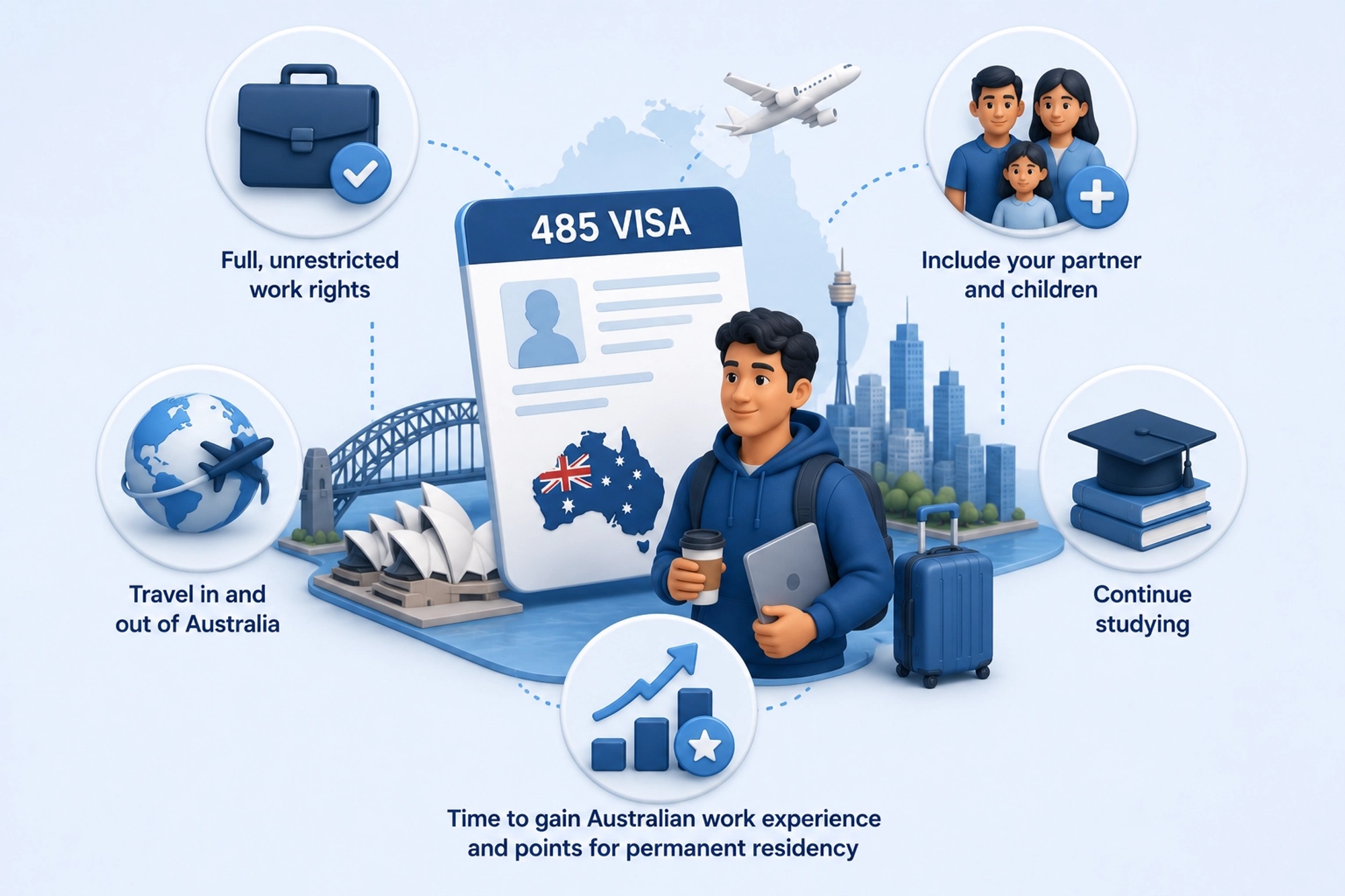
Here is what the 485 visa gives you during its validity:
- Full, unrestricted work rights — any employer, any industry, any hours. No sponsorship needed.
- The right to include your partner and dependent children as secondary applicants
- The right to travel in and out of Australia freely
- The right to continue studying in Australia if you choose
- Time to accumulate the Australian work experience and points needed for skilled migration pathways to permanent residency
It is not a guaranteed path to PR — but it is the bridge between study and everything that comes next, and for most international graduates, it is the most important visa they will ever apply for.
SettleMate's Tip: SettleMate recommends starting your 485 application preparation at least two months before your course completion date — not after you receive your final results. That means getting your English test done, ordering your AFP check, and researching the correct stream before you graduate. The 6-month lodgement window feels long until you realise your AFP check takes 4–8 weeks and your IELTS needs to be retaken.
The Three Visa Streams: Which One Is Yours?
The 485 visa has three separate streams. Choosing the wrong one is a common cause of refusal. Read these carefully.
🎓 Stream 1: Post-Higher Education Work Stream
Who it's for: Graduates with a bachelor's degree (including bachelor with honours), master's degree (coursework or by research), or a doctoral degree from an Australian institution.
Important change from December 2024: Graduate Certificates no longer qualify for this stream. Graduate Diplomas qualify only if they were studied after completing an Australian bachelor's degree. If your highest qualification is a standalone Graduate Certificate, you need to check your eligibility carefully — this stream may not apply to you.
Visa duration:
- Bachelor's or Master's by Coursework: 2 years
- Master's by Research or PhD: 3 years
- Hong Kong SAR or British National (Overseas) passport holders: up to 5 years across both qualification levels
For Indian nationals under AI-ECTA:
- Bachelor's with First Class Honours in STEM/ICT: 3 years
- Master's by Coursework: 3 years (instead of 2)
- PhD: 4 years (instead of 3)
🔧 Stream 2: Post-Vocational Education Work Stream
Who it's for: Graduates with an associate degree, diploma, or trade qualification that is linked to an occupation on the relevant skilled occupation list.
This stream requires a skills assessment in your nominated occupation from the relevant assessing authority. Not all diploma or vocational qualifications qualify — your course must link to an eligible occupation.
Visa duration: Up to 18 months
- Hong Kong SAR or British National (Overseas) passport holders: up to 5 years
🏘️ Stream 3: Second Post-Higher Education Work Stream
Who it's for: Graduates who have already held a 485 visa under the Post-Higher Education Work stream and spent at least two years living and working in a designated regional area of Australia while on that first visa.
This stream is a separate application — not an automatic extension of your first 485 — and gives you an additional 1 to 2 years, depending on the category of regional area where you lived (Category 2 or Category 3).
If you did not live and work regionally during your first 485 visa, this stream is not available to you.
Eligibility: Do You Qualify?
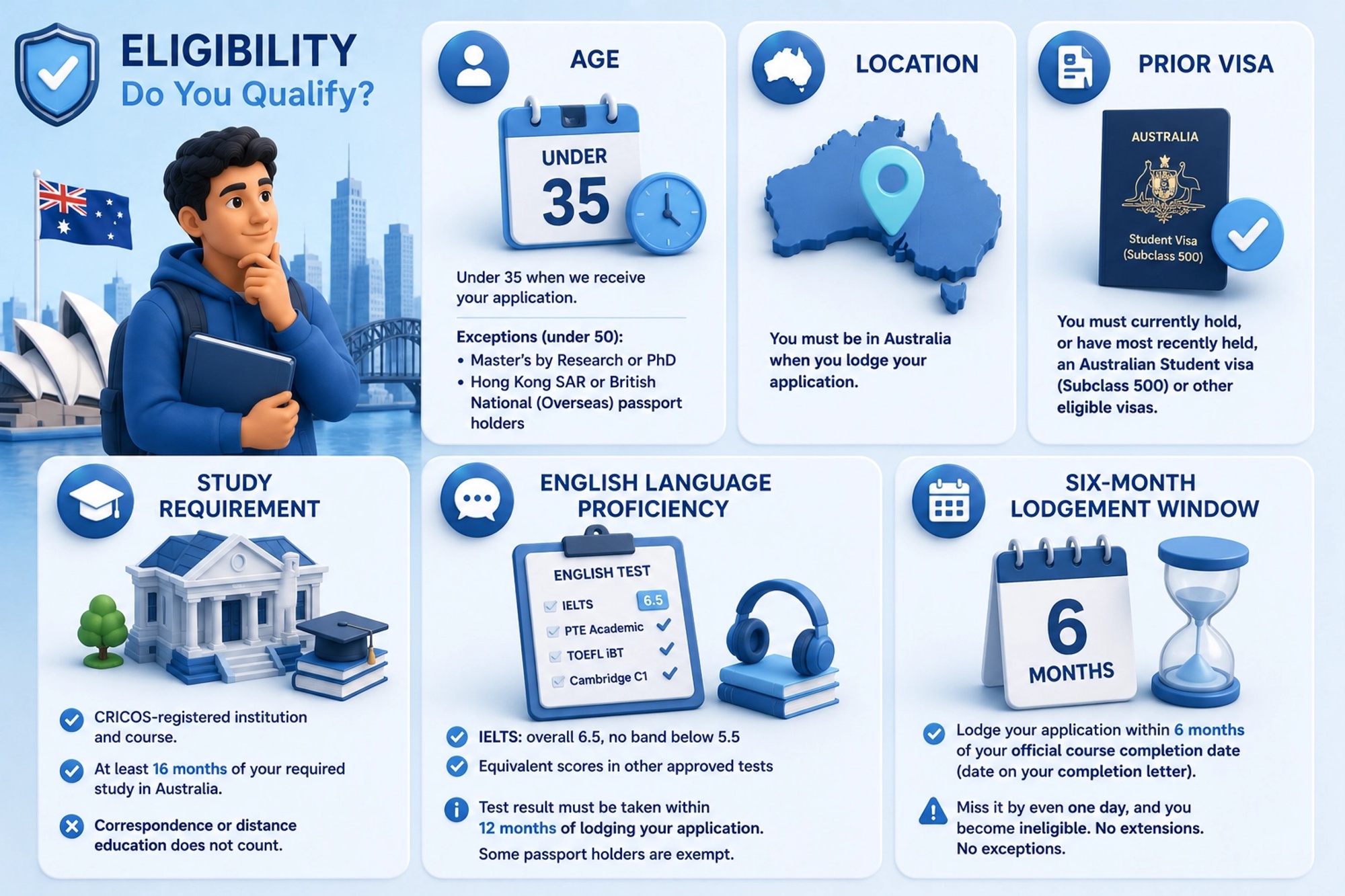
All three streams share a core set of requirements. You must meet all of these before lodging.
✅ Age
You must be under 35 years old when the Department of Home Affairs receives your application.
Exceptions:
- Graduates of a Master's by Research or PhD degree: age limit is under 50
- Hong Kong SAR or British National (Overseas) passport holders: age limit is under 50
Age is assessed on the day the Department receives your application — not when you start preparing it.
✅ Location
You must be in Australia when you lodge your application. Offshore applications are not accepted.
✅ Prior Visa
You must currently hold, or have most recently held, an Australian Student visa (Subclass 500) or certain other eligible visas within the prescribed period. In most cases this means you lodged your student visa and studied in Australia on it.
✅ Study Requirement
Your qualification must be from a CRICOS-registered institution and course. You must have spent at least 16 months of your required study period in Australia. Correspondence or distance education does not count toward the Australian study requirement.
✅ English Language Proficiency
You must provide a valid English test result showing:
- IELTS: overall score of 6.5, with no individual band (listening, reading, writing, speaking) below 5.5
- Equivalent scores in PTE Academic, TOEFL iBT, Cambridge C1 Advanced, or other approved tests
Critical rule: Your test result must have been taken within 12 months of the date you lodge your application. The old three-year validity is gone. If your test result is older than 12 months, you will need to retake it.
Some passport holders are exempt from the English test requirement — check immi.homeaffairs.gov.au for the current exemption list by nationality. UK, USA, Canada, New Zealand, and Ireland passport holders are among those currently exempt.
✅ Six-Month Lodgement Window
You must lodge your application within 6 months of your official course completion date. This date is the date on your formal completion letter from your education provider — not when you attend graduation, not when results are released, not when you receive your testamur.
If you miss this window by even one day, you become ineligible. There are no extensions. No exceptions. This is one of the most common causes of ineligibility.
SettleMate's Tip: SettleMate recommends requesting your official completion letter from your education provider immediately after your final results are confirmed — not after your graduation ceremony. The 6-month clock starts from the date on that letter, and processing your AFP check, organising OVHC insurance, and preparing documents all take time. Give yourself as much of that 6-month window as possible.
What Documents Do You Need?
Gather every document before you open ImmiAccount. Incomplete applications are the single biggest cause of delays and additional requests.
Essential documents for all applicants:
- Valid passport (must cover your intended visa period)
- Official course completion letter from your education provider (confirms your completion date)
- Academic transcripts (certified or official)
- English test results (IELTS, PTE, TOEFL, or equivalent — taken within the last 12 months)
- Australian Federal Police (AFP) National Police Check — must be dated no more than 12 months before application
- Overseas Visitor Health Cover (OVHC) — see the dedicated section below, this is critical
- Overseas police clearances if you have lived in a country other than Australia or your home country for 12 months or more after the age of 16
- Proof of student visa (your current visa grant or ImmiAccount confirmation)
Additional documents for specific streams:
- Post-Vocational Education Work Stream: skills assessment from the relevant assessing authority in your nominated occupation
- Second Post-Higher Education Work Stream: evidence of regional residency and employment during your first 485 visa (rental agreements, payslips, letters from employers)
For secondary applicants (partner, children):
- Passport for each applicant
- Evidence of relationship (marriage certificate, de facto evidence)
- Police clearances
- Health insurance coverage for each person included in the application
The Health Insurance Question Everyone Gets Wrong: OSHC vs OVHC
This is the single most common document mistake on 485 applications, and at $4,600 per application it is an expensive one. Read this section carefully.
OSHC (Overseas Student Health Cover) is the insurance you held during your Student visa. It is specifically designed for student visa holders. The moment your student visa expires, OSHC is no longer valid for compliance purposes.
OVHC (Overseas Visitor Health Cover) is what you need for your 485 application and visa.
Here is how it works in practice:
If you are still on your Student visa when you lodge your 485 application, you can use your current OSHC as evidence at lodgement. However, you must also provide evidence of OVHC that begins when your Student visa ends — because OSHC cannot cover the period you will be on a Bridging Visa A or the 485 itself.
If you receive your 485 visa grant before your Student visa expires, you need to switch to OVHC immediately from the grant date.
The rule: Your 485 visa carries Condition 8501 — the legal requirement to maintain adequate health insurance for the duration of your visa. OSHC does not satisfy Condition 8501 on a 485 visa. OVHC does.
Budget for OVHC: Expect to pay approximately $110–$140 per month for a single applicant, depending on the provider and policy tier. Unlike OSHC, OVHC can be paid monthly rather than upfront for the full duration. Providers include Bupa, Medibank, nib, Allianz Care, and AIA.
A practical tip: line up your OVHC with a start date aligned to the day after your Student visa expires. Most insurers allow you to bring the start date forward if your 485 is granted earlier, with no gap between cover.
SettleMate's Tip: SettleMate recommends purchasing your OVHC policy before you lodge your 485 application — not afterwards. At lodgement, you need to upload evidence of health insurance that will cover you from when your current insurance ends through to the likely visa grant date and beyond. Having both your OSHC certificate (if still active) and your forthcoming OVHC policy certificate ready at lodgement puts you in the strongest position.
Explore SettleMate's Settlement Hub →
Step-by-Step: How to Apply Through ImmiAccount
Once you have all your documents ready, here is exactly how to lodge your application.
🖥️ Step 1: Set up or log into your ImmiAccount
Go to online.immi.gov.au and log in with your existing account, or create one if you do not already have one. If you applied for your Student visa through an agent, you may need to create your own account — agents hold separate accounts.
Your ImmiAccount is where you will complete the application, upload all documents, pay the fee, receive correspondence from the Department, and track your application status throughout processing.
📋 Step 2: Start a new visa application
Inside ImmiAccount, select "New application" and choose Temporary Graduate visa (Subclass 485). You will be asked to select your stream — Post-Higher Education Work, Post-Vocational Education Work, or Second Post-Higher Education Work.
This stream selection is permanent. You cannot switch streams after lodgement. If you are unsure which stream applies to you, resolve this before you start the form.
📝 Step 3: Complete the application form
Work through each section carefully:
- Personal details (name, date of birth, passport details — exactly as they appear on your passport)
- Travel history (every country you have lived in for 12+ months since age 16)
- Education history (institution name, course, dates, completion date)
- Your nominated occupation (Post-Vocational stream only)
- Partner and dependant details if applicable
Upload every document as you complete each relevant section. Do not leave document uploads for later — upload as you go.
💳 Step 4: Pay the application fee
As of 1 March 2026, the government visa application charge is:
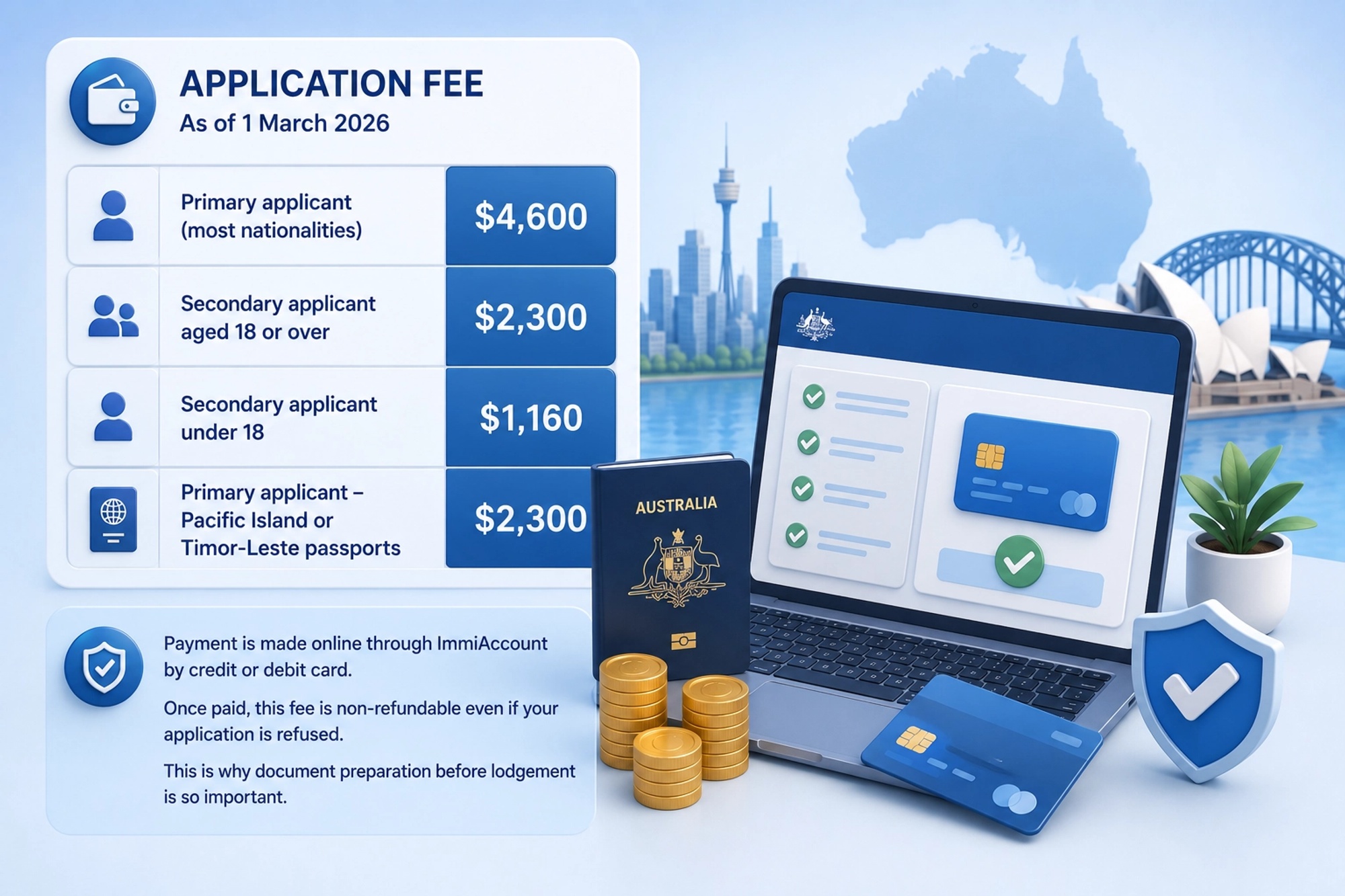
Payment is made online through ImmiAccount by credit or debit card. Once paid, this fee is non-refundable even if your application is refused. This is why document preparation before lodgement is so important.
🩺 Step 5: Book and complete your health examination
After you lodge, the Department will send instructions for your medical examination through your ImmiAccount. Medical examinations are carried out through Bupa Medical Visa Services at approved panel clinics across Australia. Book this appointment promptly — delays in completing your health check are one of the most common causes of extended processing times.
You do not need to complete the medical before lodging. Lodge first, then book the medical immediately after.
📬 Step 6: Monitor your ImmiAccount and respond promptly
After lodgement, check your ImmiAccount regularly — at minimum once a week. All communication from the Department of Home Affairs comes through ImmiAccount, including requests for additional documents and any natural justice correspondence.
If you receive a request for further information, respond within the timeframe specified. Missing a response deadline can result in your application being decided on the information already provided — which may lead to refusal.
⏳ Processing time
Current processing times for the 485 visa in 2026 are approximately 4 to 9 months, depending on your stream and how complete your application is at lodgement. Applications that are decision-ready at lodgement — meaning all documents uploaded, health examination completed promptly, and no outstanding information requests — are processed faster.
What Happens After You Lodge?
Bridging Visa A (BVA): In most cases, a Bridging Visa A is automatically granted once you lodge your 485 application and your Student visa expires. This allows you to remain in Australia legally while your application is being processed. Your BVA does not activate until your Student visa expires — while your Student visa is still active, you remain on it.
Important: A Bridging Visa A allows you to stay in Australia but generally does not allow you to leave and re-enter. If you need to travel overseas while your 485 is being processed, you must apply for a Bridging Visa B before departing. If you leave without a BVB, your BVA may be cancelled and you may be unable to return until the 485 is decided.
Health insurance during processing: Switch from OSHC to OVHC when your Student visa expires. Do not let health cover lapse at any point between your Student visa expiry and your 485 grant.
Visa grant: When your 485 visa is granted, you will be notified through your ImmiAccount. Your visa conditions, start date, and expiry date will all be confirmed in the grant letter. Check these carefully.
The Six Most Common Mistakes That Lead to Refusals
These are the reasons 485 applications are refused or delayed most often in 2026. Every one of these is avoidable.
1. Missing the 6-month lodgement deadline The clock starts from your official completion letter date — not graduation, not results release. Miss it by a day and you are ineligible.
2. Using OSHC instead of OVHC Your student health cover does not satisfy Condition 8501 on a 485 visa. Upload evidence of OVHC covering the period from when your OSHC ends through to your likely visa duration.
3. English test result older than 12 months If your IELTS, PTE, or TOEFL result was taken more than 12 months before lodgement, it will not be accepted. Book a retake before you lodge if your existing result is close to expiring.
4. Choosing the wrong stream Graduate Certificates no longer qualify for the Post-Higher Education Work stream. A standalone Graduate Diploma (not studied after a bachelor's degree) may also be ineligible. Confirm your qualification's eligibility at immi.homeaffairs.gov.au before selecting your stream.
5. Submitting an AFP check older than 12 months Your Australian Federal Police National Police Check must be dated no more than 12 months before lodgement. AFP checks can take 4–8 weeks to return — order yours as early as possible. Apply at afp.gov.au/nationally-coordinated-criminal-history-checks.
6. Not providing overseas police clearances If you have lived in any country other than Australia or your home country for a cumulative total of 12 months or more since you turned 16, you need a police clearance from that country too. This is often forgotten and can cause significant delays.
Do You Need a Migration Agent?
Honestly — for a straightforward application, no. The 485 visa is designed to be applicant-friendly, and thousands of graduates lodge successfully every year without an agent.
You probably do not need an agent if:
- Your study history is clear and uninterrupted
- You meet all eligibility criteria without any complicating factors
- You have no prior visa refusals, cancellations, or immigration issues
- You have at least 2–3 months before your 6-month deadline expires
You should seriously consider getting professional advice if:
- You have a previous visa refusal or cancellation in Australia or any other country
- Your study pathway is non-standard (multiple institutions, deferments, course changes)
- You are unsure which stream applies to your qualification
- You have gaps in your student visa history or periods without a substantive visa
- Your AFP or overseas police check reveals something that requires explanation
- Your 6-month deadline is within 4 weeks
If you proceed without an agent, take the time to read every section of the Department of Home Affairs' official 485 visa page at immi.homeaffairs.gov.au carefully — not third-party summaries — before lodging.
SettleMate's Tip: SettleMate's approach is to help you understand your own application rather than replace the process. If you are sitting on the fence, one hour with a MARA-registered migration agent for a document review before lodgement costs far less than a refusal and the lost $4,600 application fee. It is worth the investment even if you plan to handle the lodgement yourself.
SettleMate's Take
The 485 visa is genuinely doable as a self-managed application — and SettleMate has built this guide precisely so you do not have to spend thousands on a consultant for a straightforward case. But the 2026 version of this visa is significantly less forgiving than it was even two years ago. The fee has doubled, the health insurance requirement is more specific, the English test window has tightened, and the stream eligibility rules are more technical.
Know your deadline. Get your OVHC sorted before lodgement. Confirm your stream is correct before you open ImmiAccount. And order your AFP check the moment your results come through. Do those four things and the rest of the process is manageable. You already proved you could navigate an international study journey — this is just the paperwork that follows.
Frequently Asked Questions
Q: Can I apply for the 485 visa without a migration agent? Yes. Most graduates with a straightforward study history successfully apply on their own. You can lodge the entire application through ImmiAccount at online.immi.gov.au. This guide covers every step. If your case is complex — prior refusals, unusual study pathway, or visa complications — consider consulting a MARA-registered agent before lodging.
Q: What is the 485 visa fee in 2026? From 1 March 2026, the primary applicant fee is $4,600. Secondary applicants aged 18 or over pay $2,300. Children under 18 pay $1,160. Pacific Island and Timor-Leste passport holders pay $2,300 for the primary applicant. All fees are non-refundable on refusal.
Q: What health insurance do I need for the 485 visa? You need Overseas Visitor Health Cover (OVHC) — not OSHC. Your student health cover (OSHC) is only valid while you hold a Student visa. Once your Student visa expires, you must hold OVHC to satisfy Visa Condition 8501 on the 485. You can use OSHC as evidence at lodgement if your Student visa is still active, but you must also provide future-dated OVHC that begins when your OSHC ends.
Q: How long do I have to apply for a 485 visa after finishing my degree? You have 6 months from your official course completion date — the date on your formal completion letter from your education provider. This deadline is strict. Missing it by even one day makes you ineligible, with no exceptions.
Q: Can I include my partner in my 485 application? Yes. Your partner (spouse or de facto) and dependent children can be included as secondary applicants. They must each meet health and character requirements and hold appropriate health insurance. Additional government fees apply for each secondary applicant.
Q: How long does 485 visa processing take in 2026? Current processing times range from 4 to 9 months, depending on your stream and how complete your application is at lodgement. The Post-Higher Education Work stream is generally faster than the Post-Vocational stream. Applications that are decision-ready from day one — all documents uploaded, health examination completed promptly — are processed faster.
Q: What if my 485 visa application is refused? If your application is refused, you may be eligible to seek a review at the Administrative Review Tribunal (ART). Note: the former Administrative Appeals Tribunal (AAT) was replaced by the ART on 14 October 2024. Review rights and timeframes are specified in your refusal letter — act promptly, as deadlines are strict. The original $4,600 government fee is not refunded.
Q: What is the minimum English score needed for the 485 visa? IELTS 6.5 overall, with no individual band (listening, reading, writing, speaking) below 5.5. Equivalent scores in PTE Academic, TOEFL iBT, Cambridge C1 Advanced, or other approved tests are accepted. Your test must have been taken within 12 months of lodgement.
Q: Can I apply for a 485 visa from outside Australia? No. You must be in Australia when you lodge your 485 application. Offshore applications are not accepted.
📌 Official & Trusted Resources
This article is informed by:
- Department of Home Affairs — Temporary Graduate visa (Subclass 485): immi.homeaffairs.gov.au/visas/getting-a-visa/visa-listing/temporary-graduate-485
- Department of Home Affairs — Post-Higher Education Work stream: immi.homeaffairs.gov.au
- Australian Federal Police — National Police Checks: afp.gov.au
- Administrative Review Tribunal: aat.gov.au
Disclaimer
This article is for general informational purposes only and does not constitute legal or migration advice. SettleMate is not a registered migration agent. All information is current as of May 2026 per the Department of Home Affairs. Migration requirements and fees can change — always verify at immi.homeaffairs.gov.au before lodging. For personalised advice, consult a MARA-registered migration agent.
Sharing & Usage
This blog is an original content created by SettleMate. You are welcome to share, link to, or quote this blog for personal, educational, or non-commercial purposes, provided SettleMate is clearly credited as the source.
© SettleMate. All rights reserved. settlemate.au
Made with ❤️ for immigrants in Australia