Australia's 2026–27 Federal Budget: Everything Migrants Need to Know
Budget delivered 12 May 2026. This article reflects announcements as of 13 May 2026.
Treasurer Jim Chalmers handed down the 2026–27 Federal Budget on the night of 12 May 2026 — and for migrants, visa holders, and new arrivals in Australia, there is quite a bit to unpack.
This is a budget shaped by two pressures at once: a global fuel price crisis driven by the closure of the Strait of Hormuz, and a domestic cost-of-living squeeze that has been grinding Australian households for the past two years. The government's response touches tax, healthcare, housing, migration numbers, skills recognition, worker protections, and more.
SettleMate has gone through the full budget papers so you don't have to. Here is every announcement that matters to migrants — what it is, when it kicks in, and honestly, whether it actually applies to you.
💰 Tax Cuts: What Migrant Workers Actually Get
This is the headline measure of the entire budget and it is real, legislated, and affects most working migrants in Australia.
The income tax rate cut — from 1 July 2026
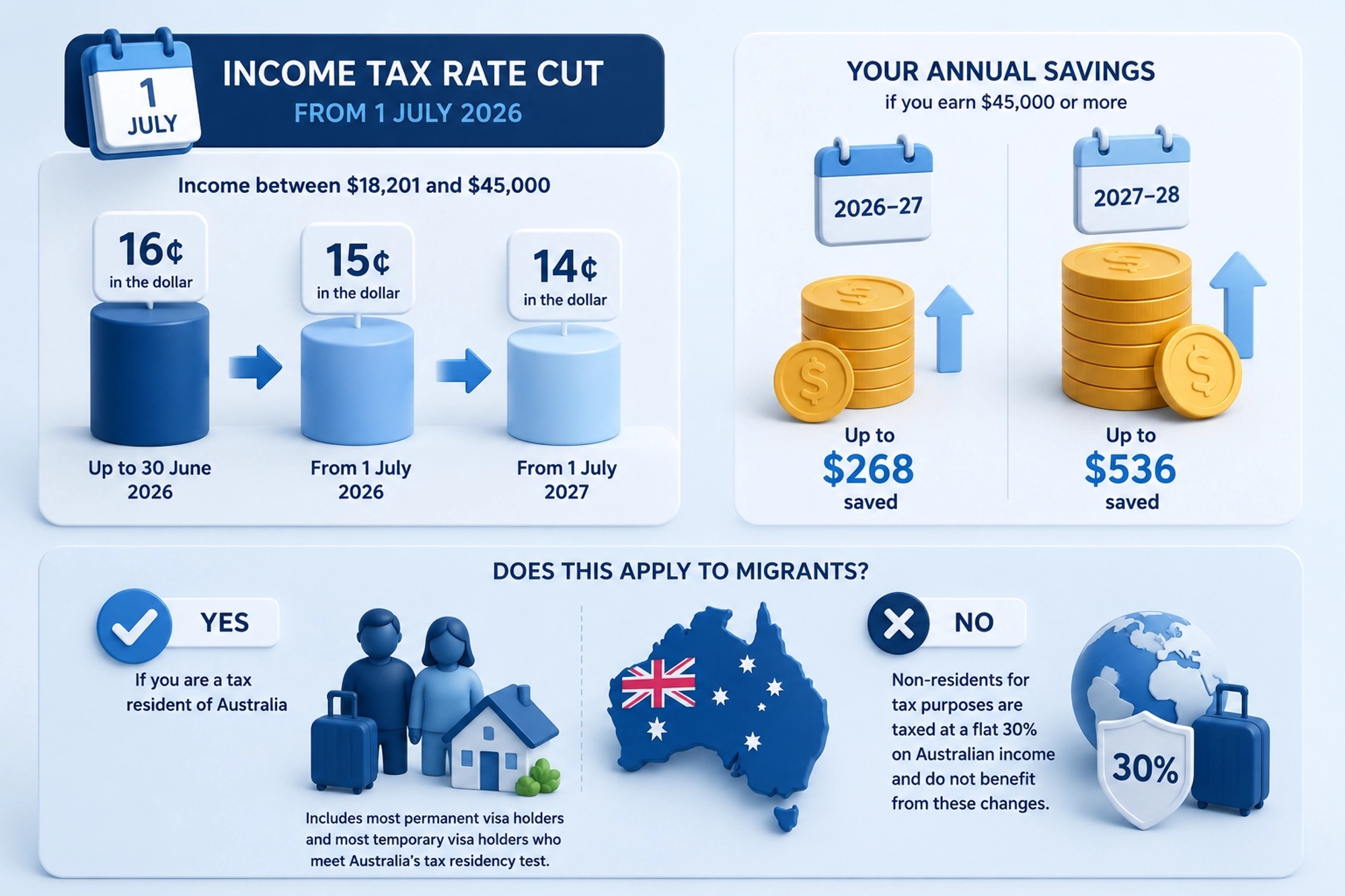
The tax rate on income between $18,201 and $45,000 is dropping from 16 cents in the dollar to 15 cents, starting 1 July 2026. Then it drops again to 14 cents from 1 July 2027.
In practical terms: if you earn $45,000 or more in the 2026–27 tax year, you will save up to $268 compared to 2025–26 tax settings. From 2027–28, that saving grows to $536 per year.
Does this apply to migrants? Yes — if you are a tax resident of Australia. This includes most permanent visa holders and most temporary visa holders who meet Australia's tax residency test (broadly, if you live and work in Australia and intend to stay, you are likely a tax resident). Non-residents for tax purposes are taxed at a flat 30% on Australian income and do not benefit from these changes.
SettleMate's Tip: Not sure whether you are an Australian tax resident? This matters enormously for how you are taxed. SettleMate recommends checking the ATO's tax residency tool at ato.gov.au, or speaking with a registered tax agent before lodging your first return. Getting residency status wrong is one of the most common and costly tax mistakes migrants make.
The $1,000 instant tax deduction — claim it in your 2026 tax return
This one is already available. From the 2025–26 financial year — meaning your tax return lodged after 1 July 2026 — you can claim a $1,000 deduction for work-related expenses without keeping any receipts. You just claim it.
This replaces the old system where you needed receipts and records for every deduction. For migrants who did not know to keep receipts throughout the year, this is directly beneficial — you get the deduction regardless.
You can still claim additional deductions on top of this $1,000, as long as those additional claims are supported by receipts.
According to government figures, 6.2 million workers — 42% of taxpayers — will benefit from an average tax saving of $205 from this measure in 2026–27.
The Working Australians Tax Offset (WATO) — $250 per year, from 2027–28
A new $250 tax offset for working Australians is being introduced, but it does not begin until the 2027–28 income year — meaning you will see it in your 2028 tax return, not this one. This offset is permanent and applies to all eligible workers.
SettleMate's Tip: SettleMate recommends that all working migrants — especially those who have never lodged an Australian tax return before — use the 2026 return as their starting point. You can claim the $1,000 instant tax deduction, benefit from the new lower 15% tax rate on income up to $45,000, and get a sense of how the Australian tax system works before more complex changes arrive in 2027–28. You can lodge your own return through myTax via myGov at my.gov.au, or use a registered tax agent.
⛽ Fuel Excise Cut: Good News If You Drive
Back in March 2026, the government cut the fuel excise — the tax embedded in petrol and diesel prices — by more than half, from 52.6 cents per litre to 20.6 cents per litre, for three months from 1 April 2026. The 2026–27 Budget allocates $2.9 billion to fund this measure.
On a 65-litre tank, that is a saving of roughly $19 per fill. If you drive regularly, this is already reducing what you pay at the pump — it does not require any action on your part.
This is particularly relevant given that transport costs rose 8.9% in the year to March 2026. The excise cut does not undo that entirely, but it takes meaningful pressure off fuel costs for migrants who rely on a car — especially those in Perth, Brisbane, Adelaide, and outer suburban areas where public transport is limited.
The government has also directed the ACCC to conduct weekly reporting on retail fuel prices and doubled maximum penalties for major breaches of competition and consumer laws to $100 million, to keep pressure on petrol companies to pass savings on.
💊 Healthcare: PBS Medicines Now Capped at $25
This one is already in effect and is a genuine win for anyone in Australia who relies on prescription medicines.
Since January 2026, the maximum price for a PBS (Pharmaceutical Benefits Scheme) prescription has been capped at $25 — the lowest level in 20 years. For pensioners and concession card holders, the cap remains at $7.70 per script.
The 2026–27 Budget invests a further $5.9 billion to list new medicines on the PBS, including treatments for cystic fibrosis, chronic kidney disease, and various cancers.
Who does this help among migrants?
If you are Medicare-eligible — which includes most permanent residents and many temporary visa holders including 482 and 485 holders — and your doctor prescribes a PBS-listed medicine, you pay a maximum of $25 per script. This is a meaningful reduction from what many migrants were paying previously.
International students on subclass 500 visas are not Medicare-eligible and must use OSHC for medicines. The PBS cap does not directly apply to OSHC-covered prescriptions, though OSHC providers are separately regulated.
Medicare Urgent Care Clinics — now permanent and expanding
The government is investing $1.8 billion to make Australia's 137 Medicare Urgent Care Clinics permanent. These clinics offer bulk-billed treatment for non-emergency health issues — no GP referral required, no out-of-pocket cost for Medicare-eligible patients.
By July 2026, four in five Australians will live within a 20-minute drive of one of these clinics. For migrants who are Medicare-eligible and have struggled to find a bulk-billing GP — which has become harder in metropolitan areas in recent years — these clinics are a practical alternative for non-emergency health needs.
SettleMate's Tip: SettleMate recommends that all Medicare-eligible migrants find their nearest Medicare Urgent Care Clinic using the healthdirect.gov.au service locator before they need it. These clinics bulk-bill all patients with a Medicare card — no gap fee — and can handle a wide range of common health issues including infections, minor injuries, skin conditions, and mental health concerns. Knowing your nearest clinic before you are sick is smart planning.
🔧 Skills Recognition: Major Win for Migrant Trades Workers
This is one of the most practically significant budget measures for migrants and it has not received nearly enough attention.
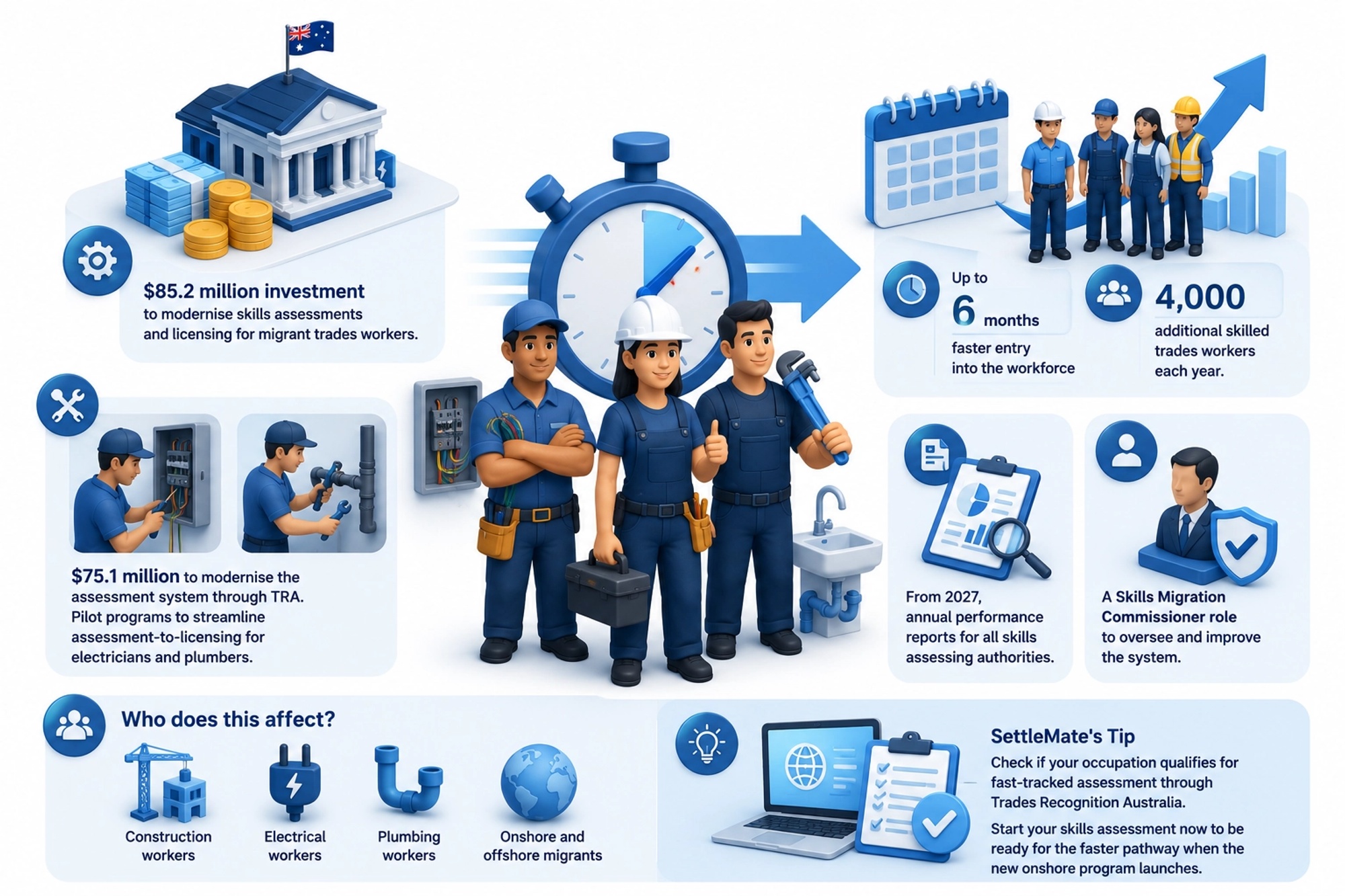
The government is investing $85.2 million to speed up skills assessments and occupational licensing for migrant trades workers. The headline outcome: these changes are expected to cut the time it takes for skilled migrants to enter the workforce by up to six months and facilitate up to 4,000 additional skilled trades workers entering the workforce each year.
Here is exactly what is changing:
$75.1 million goes to modernising the skills assessment system through Trades Recognition Australia (TRA). This includes pilot programs to streamline assessment-to-licensing in priority trades — specifically electricians and plumbers — in collaboration with state and territory governments.
A new onshore skills assessment program will be delivered by TRA specifically for visa holders already living in Australia. If you arrived with overseas trade qualifications and have been waiting to get your skills formally recognised, this program is designed for you.
From 2027, each skills assessing authority will be required to publish an annual performance report — creating accountability and transparency in a system that has historically been slow and opaque.
A Skills Migration Commissioner role is also being consulted on — a dedicated oversight role for the skilled migration and skills recognition system.
Who does this affect? This is most directly relevant to migrants in construction, electrical, plumbing, and related trade occupations — both those already in Australia on temporary visas and those offshore planning to migrate. If your overseas qualifications have not yet been recognised and it has been holding back your career or visa pathway, this investment is aimed squarely at your situation.
SettleMate's Tip: SettleMate recommends that migrant trades workers check whether their occupation qualifies for fast-tracked assessment through Trades Recognition Australia at dewr.gov.au/tra. The new onshore program has not yet launched, but TRA's existing assessment services are already available. Getting your skills assessment started now — before the new program launches — means you may be able to transition to the faster pathway once it goes live.
🛡️ Migrant Worker Protections: $27 Million to Fight Exploitation
Australia has a genuine problem with migrant worker exploitation — particularly in hospitality, agriculture, construction, and cleaning — and this budget directly addresses it.
The government is providing $27 million over two years to extend the Protecting Migrant Workers – Information and Education program. This initiative delivers targeted education and outreach to ensure migrant workers know their rights around:
- Minimum wages and entitlements under the Fair Work Act
- Superannuation obligations (particularly relevant ahead of Payday Super in July 2026)
- Visa compliance obligations and what employers can and cannot do
- How to report exploitation without risking their visa status
This matters because many migrants — particularly those on temporary visas — do not speak up about underpayment or exploitation out of fear that doing so will affect their immigration status. This program is specifically designed to address that fear by making clear that reporting workplace violations will not affect a visa.
SettleMate's Tip: SettleMate wants every migrant worker to know this clearly: reporting unpaid wages, underpaid super, or workplace exploitation to the Fair Work Ombudsman (fairwork.gov.au, 13 13 94) or the ATO will not affect your visa status. Your right to fair pay is protected under Australian law regardless of your visa type. If you have been underpaid or exploited, you can report it safely.
🌏 Migration Program: 185,000 Places — But Onshore Gets Priority
The permanent migration program cap remains at 185,000 places for 2026–27, unchanged from last year. The broad allocation remains over 70% for skilled migrants and the rest for family stream.
The most significant policy shift, however, is the strong prioritisation of onshore migrants — people already living in Australia — across both the skilled and family streams. Budget papers confirm that offshore places are increasingly being directed toward highly skilled candidates who address Australia's long-term needs.
What this means practically: if you are already in Australia on a temporary visa and planning a PR application, your queue position is now being given preference over equivalent applicants who are offshore. This is a meaningful structural advantage for onshore migrants that was not as explicit in previous years.
Net overseas migration has already dropped around 45% from its 2022–23 peak of 528,000 and is forecast to continue declining to 225,000 by 2027–28 as the government stabilises migration numbers.
🎒 Working Holiday Makers: Ballot System Coming
If you are on or planning a Working Holiday visa (subclass 417 or 462), there is an important change flagged in this budget.
The government has announced reforms to the Working Holiday Maker (WHM) program aimed at "better controlling numbers" and providing a "fairer allocation" of WHM visas. The key measure: expanding the use of ballots in the WHM program to manage demand.
The details of how ballots will work — which nationalities are affected, which visa subclasses, what the process looks like — have not yet been released. What is confirmed is that the intention is to move away from a pure first-come-first-served application system toward a ballot or lottery-style allocation for certain nationalities or caps.
SettleMate will publish a dedicated update on WHM ballot changes as soon as the full details are confirmed by the Department of Home Affairs.
SettleMate's Tip: If you are planning to apply for a Working Holiday visa and your preferred country's allocation is known to be competitive (the UK, Germany, France, and several others have annual caps that fill quickly), SettleMate recommends monitoring the Department of Home Affairs website closely at immi.homeaffairs.gov.au for announcements about the ballot system. Acting quickly when a ballot opens — rather than waiting — is the safest strategy in a ballot-based system.
🗣️ English Program for Migrants: Reformed From 2029
The Adult Migrant English Program (AMEP) — Australia's free English tuition service for eligible migrants and humanitarian entrants — is being reformed. The new model will not commence until 1 January 2029, so nothing changes right now.
From 2029, the new program will offer more flexible tuition and better student supports to improve both English-language outcomes and employment pathways. The government is particularly focused on migrants who are most in need of English language support for workforce participation.
Currently, eligible migrants can access AMEP free of charge through TAFE and registered providers. If you are eligible and have not yet used it, the existing program continues in full until 2029.
📋 The Points Test Is Being "Optimised" — But Details Are Vague
This one deserves a completely separate blog — and SettleMate will publish one.
What the budget confirms: the government will "optimise" the permanent migration points test, which selects almost two-thirds of all permanent skilled migrants. The stated goal is to prioritise "better educated", "higher-skilled", and younger migrants. Beyond that directional statement, no detailed reforms have been released as of budget night.
SettleMate's read: this is a genuine and significant coming change, but the lack of detail in the budget papers means it is still in consultation and development. The SettleMate blog on the points system covers everything announced so far.
What This Budget Does NOT Do for Migrants
In the interest of giving you the full picture, here is what the budget did not announce or did not apply to migrants:
- Commonwealth Rent Assistance increases were confirmed as ongoing, but this payment is generally available only to permanent residents and some eligible temporary visa holders receiving other Centrelink payments. Most new temporary visa holders are not eligible.
- The $250 Working Australians Tax Offset does not begin until the 2027–28 tax year — it will not appear in your 2026 or 2027 tax return.
- International students on subclass 500 do not benefit from the PBS $25 medicine cap (OSHC covers them separately) and are not Medicare-eligible for Urgent Care Clinics.
- The housing negative gearing and CGT changes affect property investors. Most migrants in their early settlement years are renters, not property investors, so these changes have limited immediate practical impact — though over a longer timeline, if successful, they may help moderate property prices.
SettleMate's Take
For migrants, this is a budget with genuine wins buried inside a lot of big-picture announcements. The tax cuts are real and will put more money in the pockets of most working migrants from 1 July. The $1,000 instant tax deduction is available right now for this year's return. PBS medicines at $25 is already saving money at the pharmacy. And the $85.2 million skills recognition investment — if delivered well — could meaningfully shorten the time it takes migrant trades workers to get their qualifications recognised and start earning what they are actually worth.
The working holiday maker ballot and the points test changes are the two things to watch closely. Neither has full details yet. SettleMate will publish dedicated updates on both as the Department of Home Affairs releases more information.
Frequently Asked Questions
Q: When was the 2026–27 Federal Budget delivered? Treasurer Jim Chalmers delivered the 2026–27 Federal Budget on the night of 12 May 2026.
Q: Do the income tax cuts apply to migrants? Yes — if you are an Australian tax resident. The tax rate on income between $18,201 and $45,000 drops from 16% to 15% from 1 July 2026. Non-residents for tax purposes are taxed at a flat rate and do not benefit from this change. If you are unsure of your tax residency status, check ato.gov.au or speak with a registered tax agent.
Q: What is the $1,000 instant tax deduction and can migrants use it? Any Australian tax resident who earns work-related income can claim a $1,000 deduction on their tax return without keeping receipts, from the 2025–26 financial year onwards. This means you can claim it in the tax return you lodge after 1 July 2026. It applies regardless of visa type, as long as you are a tax resident.
Q: Are PBS medicines now cheaper for migrants? If you are Medicare-eligible (which includes most permanent residents and many temporary visa holders on 482, 485, and similar visas), PBS prescription medicines are now capped at $25 per script — the lowest price in 20 years, effective since January 2026. International students on subclass 500 are not Medicare-eligible and are covered separately through OSHC.
Q: What is changing for working holiday makers in the budget? The government has announced it will expand the use of ballots in the Working Holiday Maker program to better manage demand. Full details — including which nationalities are affected and how the ballot will work — have not yet been released. SettleMate will publish a dedicated update once the Department of Home Affairs confirms the specifics.
Q: Does the budget help migrant workers who have been underpaid? Yes — the $27 million Protecting Migrant Workers program provides education and outreach to ensure migrants know their rights around wages, super, and workplace protections. Importantly, reporting underpayment to the Fair Work Ombudsman or ATO will not affect your visa status. Contact Fair Work on 13 13 94 or at fairwork.gov.au.
Q: What is happening to the permanent migration program? The cap remains at 185,000 places for 2026–27, with over 70% allocated to skilled migrants. The key policy shift is the strong prioritisation of onshore migrants — those already living in Australia — across both skilled and family streams.
Q: What is the skills assessment reform and who does it affect? The government is investing $85.2 million to speed up skills assessments and occupational licensing for migrant trades workers. This is most directly relevant to electricians, plumbers, and other trades workers with overseas qualifications who have been waiting for formal recognition. A new onshore assessment program through Trades Recognition Australia is being developed. Check dewr.gov.au/tra for the latest.
📌 Official & Trusted Resources
This article is informed by:
- Australian Federal Budget 2026–27 papers: budget.gov.au
- Treasury Ministers — Budget Speech 2026–27: ministers.treasury.gov.au
- Department of Health and Aged Care — Budget 2026–27: health.gov.au
- SBS News — Budget migration coverage: sbs.com.au
- Visa Envoy — Federal Budget 2026–27 migration analysis: visaenvoy.com
- Ethos Migration Lawyers — Budget 2026–27 corporate migration analysis: ethosmigration.com.au
Disclaimer
This article is for general informational purposes only and does not constitute legal, migration, tax, or financial advice. SettleMate is not a registered migration agent or tax agent. Always verify information through official Australian government sources. For visa and migration matters, consult a registered migration agent (MARA agent). For tax matters, consult a registered tax agent.
Sharing & Usage
This blog is an original content created by SettleMate. You are welcome to share, link to, or quote this blog for personal, educational, or non-commercial purposes, provided SettleMate is clearly credited as the source.
© SettleMate. All rights reserved. settlemate.au
Made with ❤️ for immigrants in Australia